Think about falling in love.
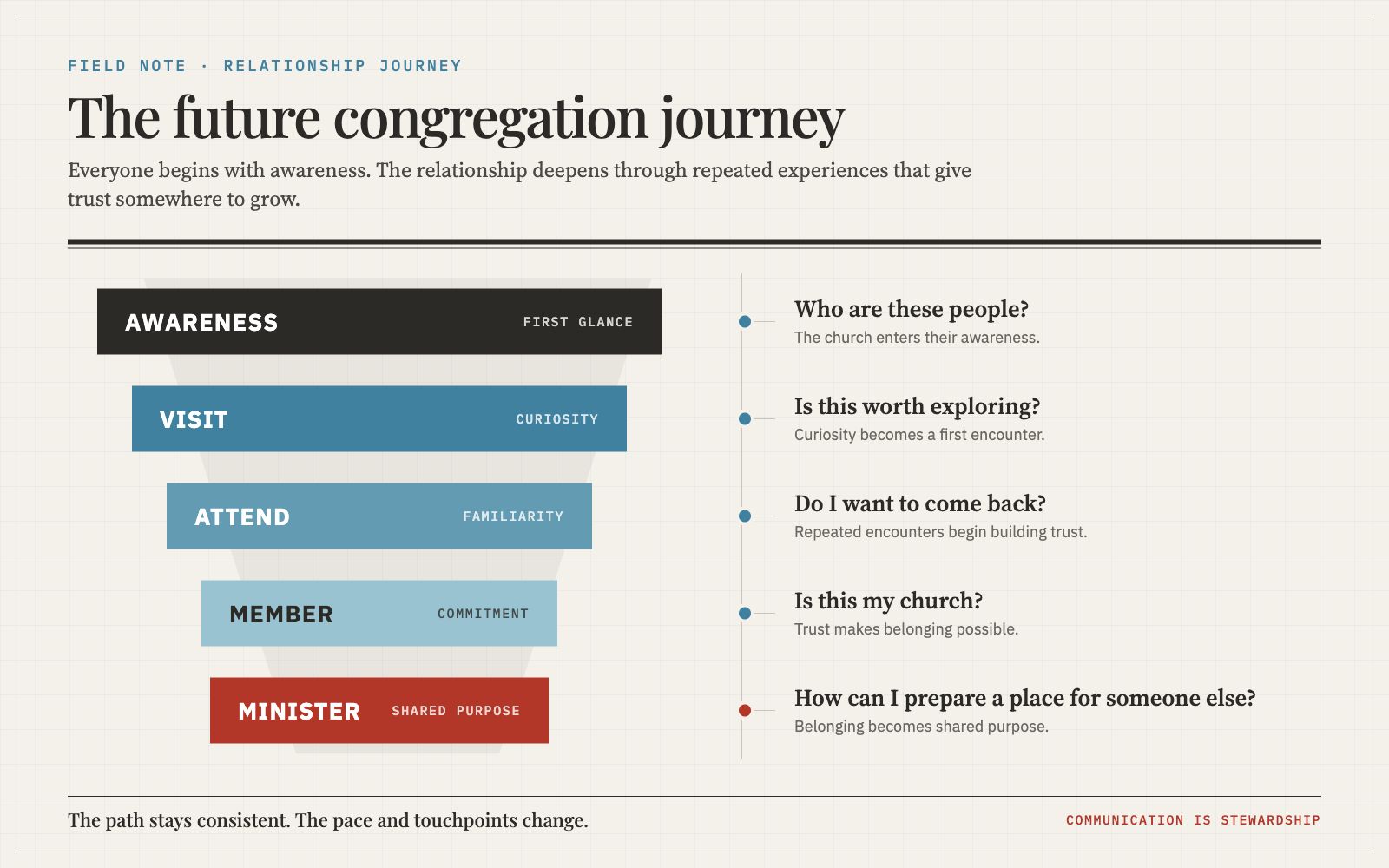
There is a first glance. Something makes you curious. Curiosity creates an encounter. Repeated encounters create familiarity. Familiarity gives trust somewhere to grow. Trust makes commitment possible. Commitment eventually becomes belonging and shared purpose.
No one begins with commitment. Even love at first sight begins with sight.
The journey is older than marketing
Marketing did not invent the customer journey. It follows a pattern that has always been present in human relationships.
The church is not trying to manufacture affection for an institution. The point is simpler and truer than that: relationships form over time, through repeated experiences in which words and actions agree.
That is true of friendship, marriage, community, faith, and belonging to a church. You can't shortcut your way to trust. You earn it over time.
The path is well worn
The Future Congregation Journey names the same movement in a church.
- Awareness asks, who are these people?
- Visit asks, is this worth exploring?
- Attend asks, do I want to come back?
- Member asks, is this my church?
- Minister asks, how can I help prepare a place for someone else?
Everyone starts at awareness. Some people move through the path in a weekend. Others take years. Someone may arrive on campus already familiar with the church, because the first stages happened on YouTube, on social media, on the website, or through a trusted friend. They did not enter halfway through the journey. The church simply met them in the middle of a journey that had already begun. The path stays consistent. The pace and the touchpoints change.
The funnel is a description, not a strategy
The “funnel” describes the natural narrowing that happens as people move from awareness toward commitment. Not everyone who becomes aware will visit. Not everyone who visits will return. Jesus described this reality plainly, through images like the four soils and through his teaching about the cost of following him.
- The funnel does not tell you whom to value. It does not give you permission to pressure people through stages or treat them as leads to capture. Used well, it only helps you ask better questions.
- Where are people meeting unnecessary friction?
- What question are they trying to answer at this stage?
- Are we asking for more trust than we have earned?
- What would a clear and caring next step look like?
The funnel shows movement. The journey map shows experience.
A funnel can tell you how many people moved from awareness to a visit, from a first visit to a second, or from attending to belonging. It can show you where movement slowed or stopped. It cannot tell you what the journey felt like.
A journey map adds the person back to the movement. It asks what someone was doing, thinking, and feeling at each stage. It names the touchpoints they encountered, the questions they carried, the friction that made the next step harder, and the moments that gave trust fertile ground to grow in.
The distinction matters. A church may know that a hundred people watched a service and ten planned a visit. Those numbers describe movement. They do not explain why ninety people stopped, what the ten needed before they came, or whether the visit kept the promise made online.
The funnel gives us the shape. The journey map helps us care for the people inside it.
Trust is built at the touchpoints
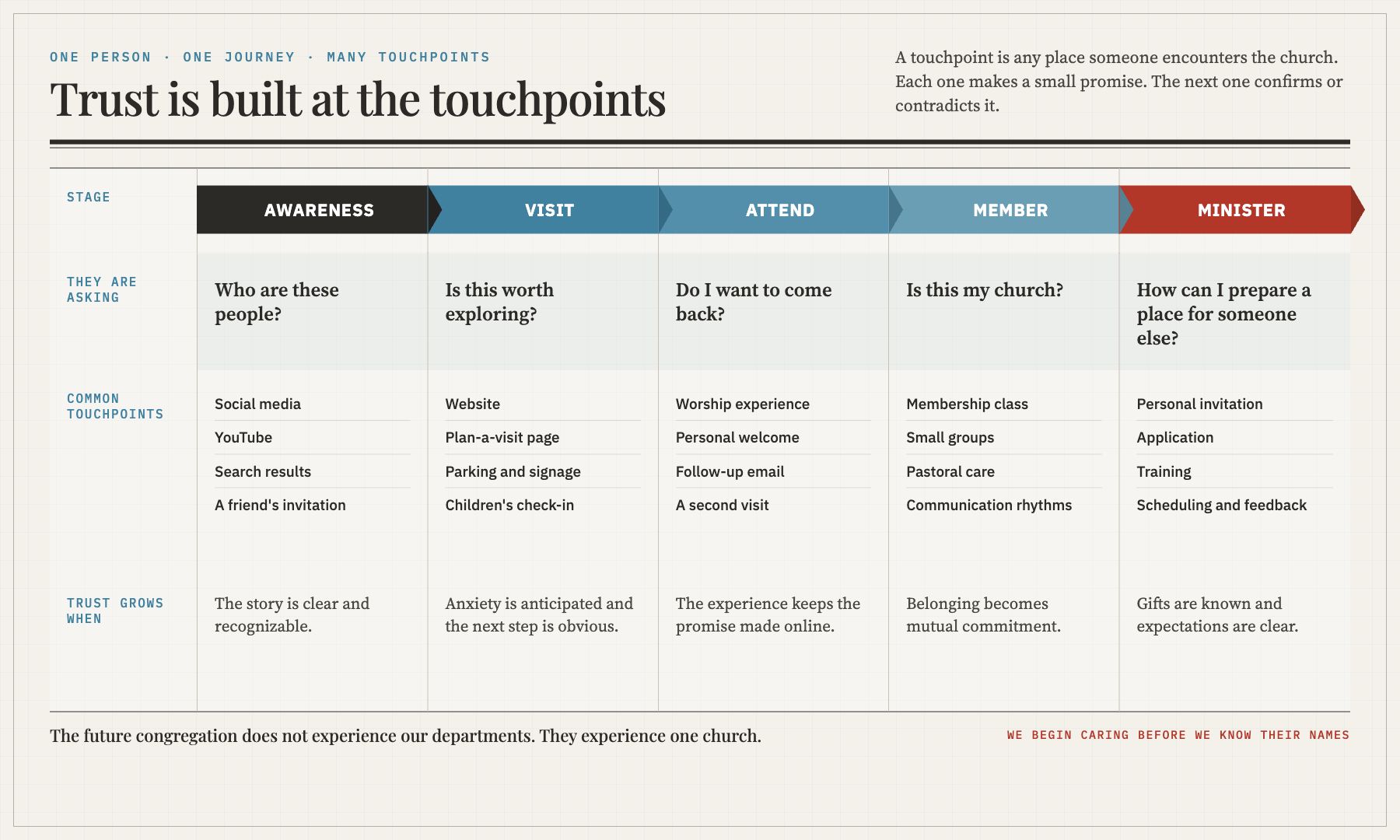
People rarely decide whether to trust a church because of one perfect message. Trust forms across a series of ordinary encounters.
The sermon clip introduces a voice. The website answers a question. The parking lot and wayfinding signs either lower anxiety or add to it. Children's check-in tells a parent whether the church understands what it feels like to hand a child to a stranger. A follow-up email shows whether the welcome was a Sunday performance or the beginning of a relationship.
Each touchpoint makes a small promise about who the church is. The next touchpoint confirms or contradicts it.
That is why communications cannot be separated from hospitality, ministry systems, or the experience on campus. The future congregation does not experience our departments. They experience the one unified story of our church.
A communications plan must serve the whole journey
Most church communications plans are really distribution plans. They tell us what will be posted, where it will appear, and when it is due. They rarely ask where the person receiving it might be in their relationship with the church.
That is how a church can publish constantly and still leave entire parts of the journey unattended.
If every video is about baptism, testimony, missions, serving, and the importance of membership, the church may be producing excellent content for people who already have context and trust. But it is saying very little to the person at awareness who is still asking, who are these people, and is any of this for me?
The opposite happens too. A church can fill social media with attractional content, warm welcome videos, polished invitations, and explanations of what to expect on a first visit. That may fill the top of the funnel, but if the communication stops there, people are welcomed into a journey the church has not helped them continue.
A comprehensive communications plan speaks to people all along the path.
- Awareness content enters the questions and concerns people are already carrying. It introduces the church's voice before asking for commitment.
- Visit content lowers anxiety. It explains what to expect, where to go, what will happen with the children, and whether someone can arrive without already knowing how church works.
- Attend content gives trust somewhere to deepen. It follows up, answers questions, introduces relationships, and makes a second or third step clear.
- Member content explains belonging, belief, baptism, generosity, care, and the commitments a church makes with its people.
- Minister content helps people recognize what God has entrusted to them and find a meaningful place to serve, lead, give, invite, and participate in the mission.
The exact content and order will differ from church to church. The responsibility does not. For every stage, someone should be asking: who is this for, what question are they carrying, which touchpoint will deliver it, and what is the next faithful step we are preparing?
Comprehensive does not mean publishing the same amount of content for every stage every week. A season may require more attention in one place. It means no stage becomes invisible. Attraction needs a handoff. Welcome needs a path toward belonging. Belonging needs a path toward shared purpose.
The goal is not to push people through a pipeline. It is to make sure that wherever someone is in the relationship, the church has cared enough to prepare the next part of the road.
Map the journey you actually created
Most teams begin by drawing the journey they hope people experience. Start with the one people are experiencing now.
Choose one research-based persona and begin at awareness. Search for the church the way that person would. Watch the sermon clip. Open the website on a phone. Try to plan a visit. Follow the signs from the street to the room. Complete the form. Read the confirmation email. Ask what happens after Sunday.
At each touchpoint, write down four things: what the person is trying to do, what question they are asking, what might create friction, and what would help them take the next faithful step.
Then listen to people who recently made the journey. Ask where they first heard about the church, what nearly stopped them, what built trust, what felt confusing, and when they began to believe they could belong. The persona work can help you turn those conversations into something a team can use.
Only then should you draw the journey you want to create.
The pace changes. The path does not.
The customer journey can sound like a marketing mechanism because business gave it a name and drew it as a diagram. But the pattern beneath it is not commercial. It is relational.
Everyone begins with awareness. Encounter creates familiarity. Familiarity gives trust somewhere to grow. Trust makes commitment possible. Some people move through that path quickly. Others take years. They may meet the church through a screen, a friend, a building, or a moment of crisis. The touchpoints change. The need for trust does not.
The church's responsibility is not to hurry people toward commitment. It is to care for the relationship at every stage, remove the obstacles we created, and make the next honest step clear.
If someone near your church is quietly beginning that journey today, would the experience you created help them keep walking?
The companion piece, Your Church Isn't for Everyone, asks the question that comes before the map: who has God called your church to prepare a place for?